The 2025 Atlantic hurricane season officially ended on November 30, 2025, bringing 13 named storms. According to the National Oceanic and Atmospheric Administration (NOAA), five storms became hurricanes, and four intensified into major hurricanes, with wind speeds surpassing 111 miles per hour (mph). An average season produces about 14 named storms, seven hurricanes, and three major hurricanes.
While this was the first season in a decade without a direct hurricane landfall in the continental United States (US), it provided local and state governments with a much-needed opportunity to reset and reflect, address readiness gaps, and begin preparing for potential changes in federal support.
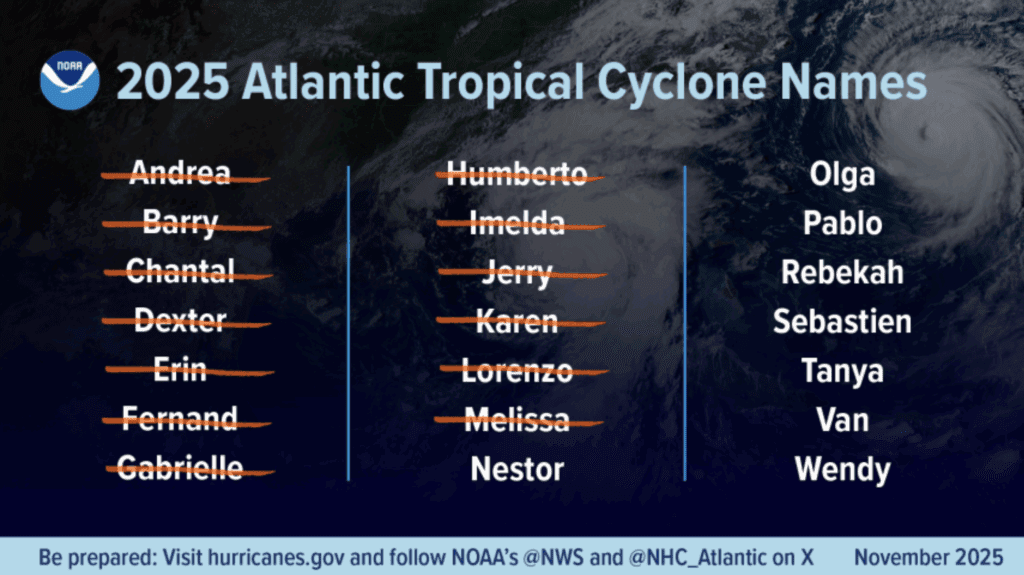
NOAA: The 13 Named Storms of 2025
The season reflected both predicted trends and surprising anomalies. While this year fell short of the preseason predictions for overall storm counts, the hurricanes that did form were exceptionally strong. NOAA’s accumulated cyclone energy (ACE) for 2025 reached 132.5 units—roughly nine percent above average—indicating an above-average season in terms of total energy.
2025 Hurricanes
The 2025 season recorded three Category (Cat) 5 hurricanes—the second-most on record for a single season. Hurricanes Erin and Humberto, which formed on August 15 and September 24, respectively, briefly reached Cat 5 intensity while passing north of the Leeward Islands. Erin, the first Atlantic basin hurricane of the season, underwent one of the fastest intensifications on record. The system strengthened to a Cat 5 with winds of up to 160 mph within one day of formation. Although Erin never came within 200 miles of the US East Coast, its expansive circulation produced storm surge, rip currents, and tropical storm conditions from the Carolinas through New England.
Hurricane Melissa—the third Cat 5 storm of the season—made history on October 28 as one of the strongest Atlantic-basin hurricanes ever to make landfall when it struck Jamaica with sustained winds of 185 mph. The storm brought torrential rains, extreme winds, and devastating flooding, resulting in catastrophic impacts across Jamaica, Hispaniola, and eastern Cuba. According to the United Nations Development Programme (UNDP), Melissa generated nearly five million tons of debris in Jamaica, disrupting transportation routes, limiting access to critical facilities, and delaying the restoration of essential services. As of December 2, an estimated 279,000 people remain displaced as a result of the storm.
Lessons Learned: Strengthening Readiness in an Evolving Landscape
While the US was spared a direct hurricane landfall this year, Hurricane Melissa was a stark reminder that it only takes one powerful storm to overwhelm local infrastructure, displace thousands, and leave lasting impacts.
Hagerty’s Director of Response, Lee Mayfield, and Deputy Director, Nicole Morales, emphasize the importance of proactive, scalable response and recovery planning. Drawing on their extensive combined experience, they highlight four actionable steps state local leaders can take to enhance disaster readiness in the off-season:
- Strengthen communication with elected leadership. Incorporate mayors, county executives, and senior administrators into emergency management planning, training, and exercises, and establish regular executive briefings to align on risks and decision-making roles.
- Deepen coordination with state and local emergency management partners. Map key contacts, maintain a recurring coordination schedule, and align local plans and exercises with state guidance and program requirements.
- Evaluate and enhance financial readiness. Assess the ability to cash-flow disasters, improve cost-tracking systems, review insurance and risk-transfer options, and pre-position compliant contracts and procurement procedures.
- Expand mutual aid and local resource networks. Strengthen regional agreements, coordinate regularly with nonprofits and private sector partners, engage philanthropic funders to address gaps, and maintain a shared inventory of community resources.
Ultimately, actions taken today determine how effectively communities will respond tomorrow. By investing in preparedness now, local leaders can transform lessons learned into tangible improvements, building systems that respond faster, recover smarter, and better protect residents.
“Now is the time to strengthen partnerships and grow your network,” Lee notes. “Acting now ensures your community is not only ready to weather the next disaster but positioned to emerge stronger, more connected, and more resilient in its aftermath.”
Resilience, Reform, and What Comes Next
While local governments focus on strengthening readiness on the ground, federal policies and funding reforms are reshaping the broader landscape of emergency management. Over the past year, the federal government has begun to redefine the nation’s disaster funding structures and policy priorities. As these changes are implemented, states and localities are assuming greater responsibility for disaster response, recovery, and resilience.
As a result, many states are moving quickly to prepare. Across the country, local leaders are assessing their capabilities, investing in resilience, modernizing emergency systems, and updating policies to respond more efficiently.
Although the 2025 hurricane season spared the US from major landfalls, these new disaster policies remain largely untested. Ultimately, now is the time for state and local governments to strengthen readiness and ensure they can operate effectively amid evolving policies, expectations, and funding realities.
Read our full blog on Federal Reform and the Future of Emergency Management.
Stay Updated and Learn More
At Hagerty Consulting, we are committed to helping our clients navigate this changing environment with foresight and strategy. In the coming weeks, we will share timely insights, innovative practices, and lessons to help communities build lasting resilience.
For continued updates on federal policy reform, funding trends, and industry best practices shaping the future of emergency management, sign up for Hagerty’s monthly newsletter.