September is National Preparedness Month (NPM), an opportunity for communities, organizations, and jurisdictions to reflect on how they prepare for, respond to, and recover from disasters. As severe weather and human-caused incidents continue to strain critical infrastructure systems across the country, now is the time for utilities to understand and prepare for potential cascading impacts.
When power outages occur, roads flood, or water systems experience failure, the operational impacts extend well beyond the initially affected system. Critical infrastructure—including power, water and wastewater, transportation, and dams—are highly interdependent and interconnected systems. A disturbance to one can potentially pose a threat to all and can lead to significant consequences for infrastructure owners and operators, government agencies, and communities. As such, preparing for potential incidents requires intentional planning and a deep understanding of system dependencies and stakeholder engagement to adequately mitigate risks.
From One Disruption to Cascading Impacts
A cascading impact occurs when the disruption of one system creates subsequent consequences for other systems. Often, the most significant vulnerabilities are not isolated to a singular infrastructure sector; they frequently exist at the intersection of multiple sectors. This can quickly escalate incidents to a much larger, more complex scale than the initial event itself. Consider the scenario below to see how a disruption to one system can lead to consequences for other systems, organizations, and communities.
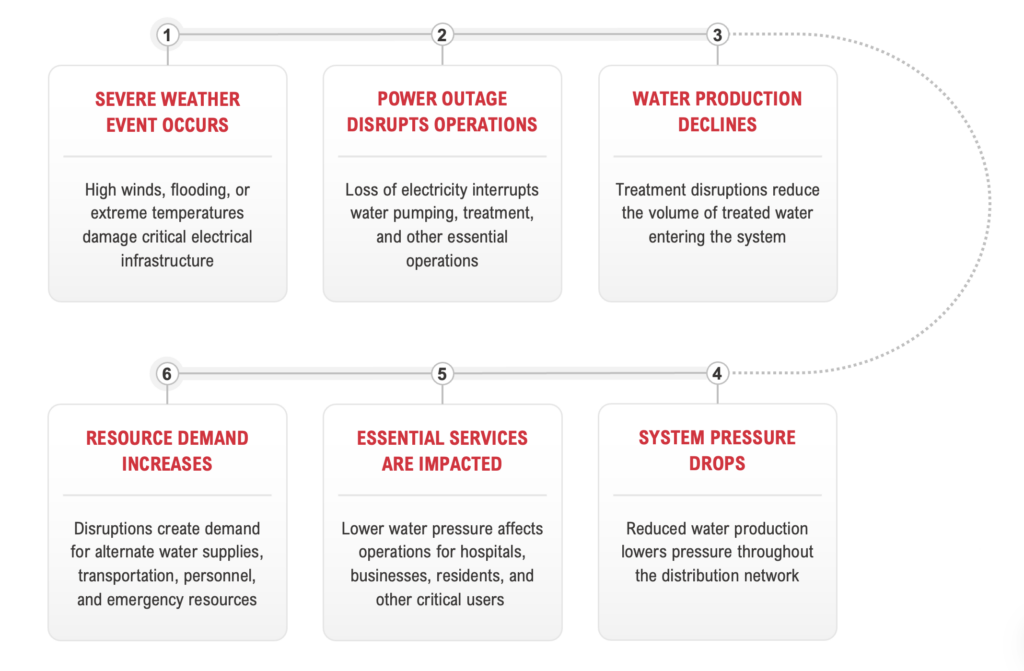
The Challenge of Interconnection
Over the past two years, disasters such as wildfires and major hurricanes have shed light on the various challenges that can come with infrastructure interdependencies. These events have exemplified how a single hazard can place simultaneous pressure on multiple systems—complicating response and recovery efforts.
Preventative measures, such as Public Safety Power Shutoffs (PSPS), also demonstrate the interdependence of infrastructure systems. While PSPS can play an important role in mitigating wildfire risks, power shutoffs of any kind can create operational challenges for critical services that rely on electricity, including water and wastewater treatment, hospitals and healthcare facilities, communications, fuel systems, and emergency response.
Further, many facilities have backup power capabilities such as generators, which require fuel. During an extended power outage, the demand for fuel often increases across multiple critical sectors at the same time. Transportation disruptions or limited fuel availability can further complicate resupply and restoration efforts.
Understanding these relationships and dependencies is essential to identifying where disruptions may occur—but it is only the first step. Organizations must use this insight to strengthen resilience, develop strategic plans, and implement targeted mitigation measures that reduce vulnerabilities and prevent disruptions from cascading across interconnected systems.
Moving From Understanding to Resilience
To prepare for cascading infrastructure impacts, organizations can take several practical steps:
- Map critical dependencies. Identify the infrastructure, organizations, resources, and services required to maintain essential operations. Determine how long the organization can tolerate the loss of each dependency and what alternatives exist.
- Identify resource constraints. Consider not only infrastructure dependencies, but the resources required to operate without them. Fuel, personnel, transportation, communications, equipment, and specialized materials may all become constrained during a prolonged event.
- Establish cross-sector relationships. Infrastructure owners, operators, and government partners should establish communication pathways and coordination protocols before an incident occurs.
- Develop prioritization strategies. When resources are limited, communities and organizations need a way to determine which services and facilities should receive priority. Establishing these criteria before an incident can help decisionmakers act efficiently.
- Exercise the interdependencies. Exercises should test what happens when dependencies fail and when partners cannot respond as expected. Testing these relationships can reveal underlying assumptions and vulnerabilities before a real disaster occurs.
How Hagerty Puts Interdependencies to the Test
Hagerty supports infrastructure owners, operators, and government partners in assessing interdependencies, identifying vulnerabilities, developing emergency and continuity plans, strengthening cross-sector coordination, and exercising complex scenarios. Our team of experts has partnered with utilities, critical infrastructure partners, and state and local governments across the country, helping organizations of all kinds prepare for cascading impacts.
Recently, Hagerty partnered with the National Emergency Management Association (NEMA) to help one state examine cascading impacts through a PSPS scenario. The exercise brought together stakeholders to assess how an extended power shutoff could disrupt critical infrastructure, essential services, and interconnected systems statewide.
Building on this work, Hagerty partnered with a county emergency management office to develop a fuel continuity plan and dashboard for managing limited fuel supplies during an extended power disruption. The effort identified the needs of critical facilities—including water systems, healthcare facilities, emergency services, and other essential operations—and provided decisionmakers with a framework to prioritize fuel distribution and maintain critical services.
Additionally, Hagerty supported a water and wastewater utility responding to the cascading impacts of a winter storm and prolonged power outage. What began as a loss of electrical service quickly created broader operational challenges, requiring coordination across functions to maintain essential services as disruptions compounded.
From dependency assessments and planning to training and exercising and incident response support, Hagerty is proud to help utilities and jurisdictions address cascading infrastructure impacts. By examining systems’ interconnectedness and building continuity plans, organizations can move from simply understanding their vulnerabilities to establishing practical resilience strategies.
Get in Touch to Learn More
Hagerty has helped utilities across the country develop their emergency management programs and facilitate communication and partnerships with their communities. For more information on how Hagerty can support your community’s utility preparedness efforts or to learn more about our work, please contact us here.