As the National Oceanic and Atmospheric Administration (NOAA) releases its 2026 hurricane season outlooks, communities across the country are evaluating how best to prepare for the months ahead. This year, NOAA forecasts a below-normal Atlantic hurricane season, while above-normal activity is expected across the Central and Eastern Pacific Basins.
At the same time, evolving federal disaster policies are placing greater responsibility on state and local governments to lead preparedness, response, and recovery efforts. As a result, proactive planning, coordination, and resource readiness at the local level will play a critical role in how effectively communities withstand and recover from seasonal storm impacts.
2026 Hurricane and Tropical Cyclone Outlook
NOAA’s 2026 official season outlook provides an early look at potential storm activity across both the Atlantic and Pacific basins. Understanding these forecasts can help communities, local leaders, and emergency managers prepare effectively.
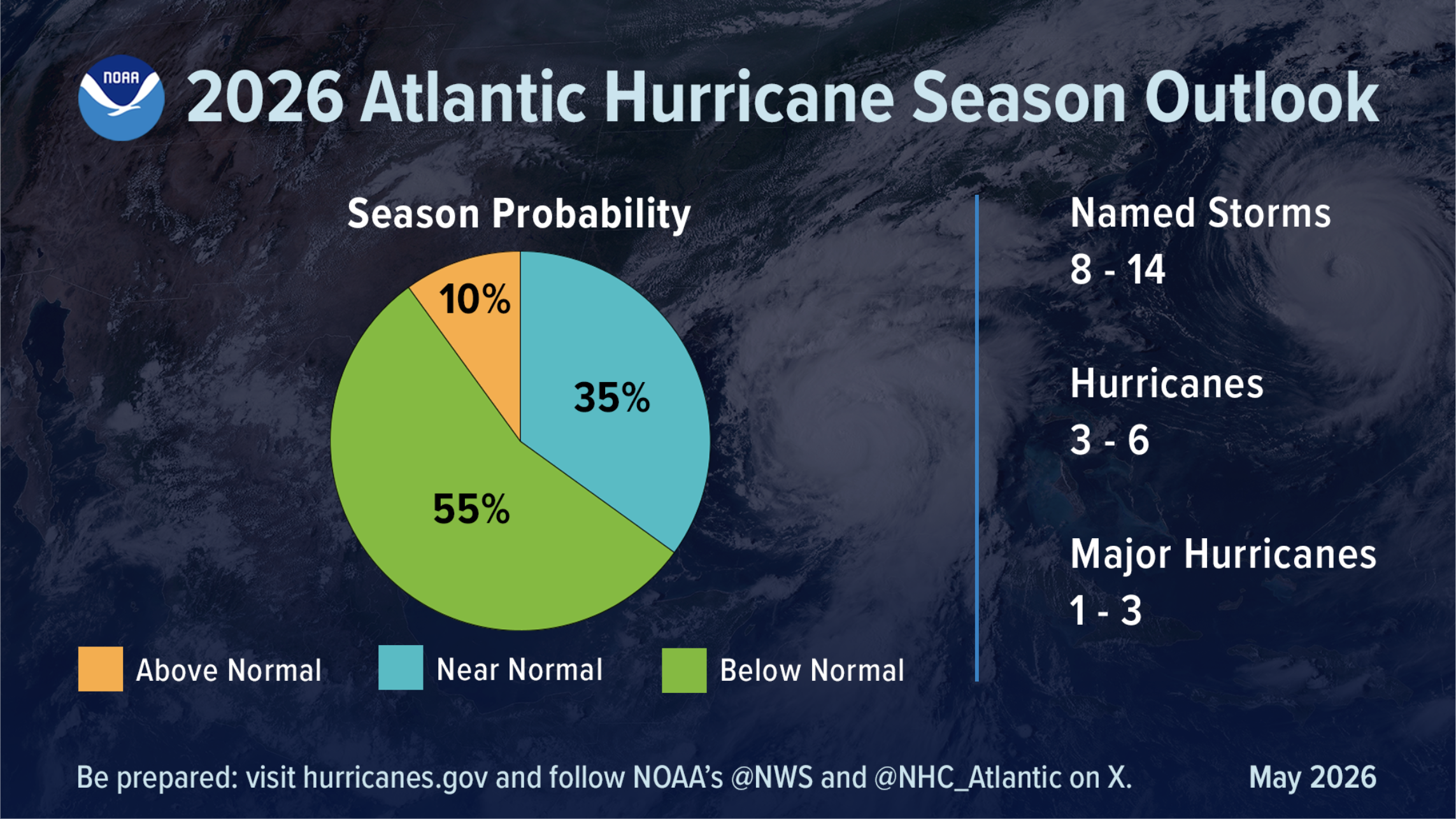
NOAA: Atlantic Hurricane Season Outlook
Atlantic Hurricane Season
In the Atlantic, NOAA’s Climate Prediction Center (CPC) projects a 55 percent chance of below-normal activity this year. Beginning June 1 and continuing through November 30, the season could bring:
- Eight to 14 named storms (winds of 39 miles per hour (mph) or greater)
- Three to six hurricanes (winds of 74 mph or greater)
- One to three major hurricanes (Category (Cat) 3, Cat 4, or Cat 5 storms, winds of 111 mph or greater)
Forecasters attribute these projections to several competing climate factors. According to NOAA, moderate-to-strong El Niño conditions are expected to develop throughout the hurricane season, which typically suppresses tropical storm and hurricane activity in the Atlantic Basin. At the same time, sea surface temperatures across the Atlantic are forecast to remain slightly above normal, while trade winds are expected to be weaker than average — conditions that can support storm development and intensification.
Due to these conflicting influences, NOAA cautions that uncertainty remains regarding how active this season may ultimately become.
“Although El Niño’s impact in the Atlantic Basin can often suppress hurricane development, there is still uncertainty in how each season will unfold,” said NOAA National Weather Service (NWS) Director Ken Graham.
NOAA also emphasized that seasonal outlooks do not predict where or when storms may make landfall, underscoring the importance of preparedness regardless of the forecasted activity level.
Pacific Hurricane Season
While the Atlantic is expected to experience a below-normal season, NOAA’s outlook for the Pacific basin predicts active seasons across both the Central and Eastern Pacific. In the Central Pacific, forecasters project a 70 percent chance of above-normal activity, with between five and 13 named storms expected throughout the season, which runs from June 1 through November 30.
The Eastern Pacific outlook is similarly active, with NOAA forecasting between 15 to 22 named storms, nine to 14 hurricanes, and five to nine major hurricanes during the season, which officially began May 15 and continues through November 30.
According to forecasters, this heightened Pacific activity is largely tied to the anticipated development of El Niño conditions during the peak months of hurricane season. While El Niño typically suppresses activity in the Atlantic, it often has the opposite effect in the Pacific, creating a more favorable environment for tropical cyclone development. Combined with warmer-than-average ocean temperatures and below-normal vertical wind shear, these conditions are expected to support increased storm formation and intensification across the region.
State and Local Governments: The First Line of Defense
Recent federal policy shifts reflect a broader push to increase operational and financial responsibility for disaster response and recovery at the state and local level. Hagerty’s Director of Response, Lee Mayfield, notes that many of the recommendations in the FEMA Review Council Report—if implemented—would directly impact how jurisdictions plan for, respond to, and recover from hurricanes. While some changes would take time to put into place, others could begin influencing this upcoming hurricane season.
These near-term shifts include:
- Increased emphasis on state and local leadership during response operations
- Fewer or delayed federal disaster declarations for lower-impact tropical storms and hurricanes
- More selective declarations, prioritizing the most impactful or significant events
- Greater uncertainty around which storms will receive declarations and how quickly assistance will follow
Mayfield emphasizes that while uncertainty is not new for emergency managers, it may become more pronounced as elements of the Review Council’s recommendations move closer to implementation. In this environment, understanding what may shift this hurricane season can help state and local leaders stay ahead of emerging challenges and better position their response efforts.
Hurricane Readiness: Practical Steps for Local Leaders
To help jurisdictions prepare, Mayfield recommends several practical steps ahead of the season:
- Review the FEMA Review Council Report in detail and understand potential short- and long-term operational and financial implications. Be prepared to brief your leadership team on what the recommendations could mean for your agency this season and beyond.
- Know your state and local resources across response functions, including search and rescue, mutual aid, Emergency Operations Center (EOC) augmentation, Incident Management Team (IMT) support, and vendor contracts. If you have not already, schedule pre-hurricane season stakeholder meetings now and ensure leaders clearly understand how the resource request process works by practicing those processes in advance.
- Strengthen decision-making for life safety and protective actions decisions ahead of a hurricane landfall (e.g., evacuation and sheltering) by understanding the tools you will rely on and building a strong relationship with your local NWS office. Bookmark key resources that will be used during EOC activations, and ensure clarity on when and how each tool should be applied. The decision support services provided by the NWS and National Hurricane Center (NHC) are essential for informed emergency management decisions.
- Invest in preparing your team for long-duration EOC activations. While emergency managers are often focused outward—building coalitions that will pay dividends once the room is full during a disaster—it is equally important to prioritize internal readiness. Strengthen team camaraderie, ensure staff have time to prepare their homes and families, and allow personnel to take some well-deserved time away from the office ahead of what could be a busy hurricane season.
Know Your Risks, Be Prepared
This hurricane season, state and local leaders will play an enhanced role in mobilizing resources, communicating clearly with residents, and guiding early action. At the same time, individuals and organizations can take practical steps to protect themselves and their communities.
By knowing your risks, reviewing emergency plans, preparing supplies, and staying informed, you can reduce the impact of storms and weather the season safely. Ultimately, preparedness is not just a recommendation—it is a shared responsibility that helps communities stay safe and recover faster.
Throughout the hurricane season, Hagerty will continue to provide guidance on emergency preparedness, response coordination, and long-term recovery planning. For ongoing insights into federal policy changes, funding trends, and updates on the latest hurricanes and extreme weather events, sign up for Hagerty’s monthly newsletter.