For the past several years, the Building Resilient Infrastructure and Communities (BRIC) program has created a clear divide among applicants: those who have consistently secured funding—and those who have not.
The most successful applicants treated BRIC as more than a grant program. They invested early in project design, aligned proposals tightly to infrastructure risk reduction, and sought capabilities to navigate the Federal Emergency Management Agency’s (FEMA) technical and administrative requirements. These communities approached BRIC strategically—and were rewarded accordingly.
Others, however, encountered a very different experience. Despite strong mitigation needs, many states and localities struggled to compete. Applications were often slowed by limited design progress, constrained local capacity, or difficulty navigating an increasingly complex scoring process. Over time, frustration grew as funding concentrated among a smaller group of repeat recipients, leaving many communities effectively locked out of the program.
Although hundreds of millions of dollars in projects have been selected, the obligation of those funds often lags behind award announcements. Lengthy federal review processes—including environmental compliance, benefit-cost validation, and scope refinement—can delay access to funding, sometimes for extended periods. For communities, this reinforces the importance of developing well-defined, implementation-ready projects that can move efficiently through FEMA’s post-selection requirements.
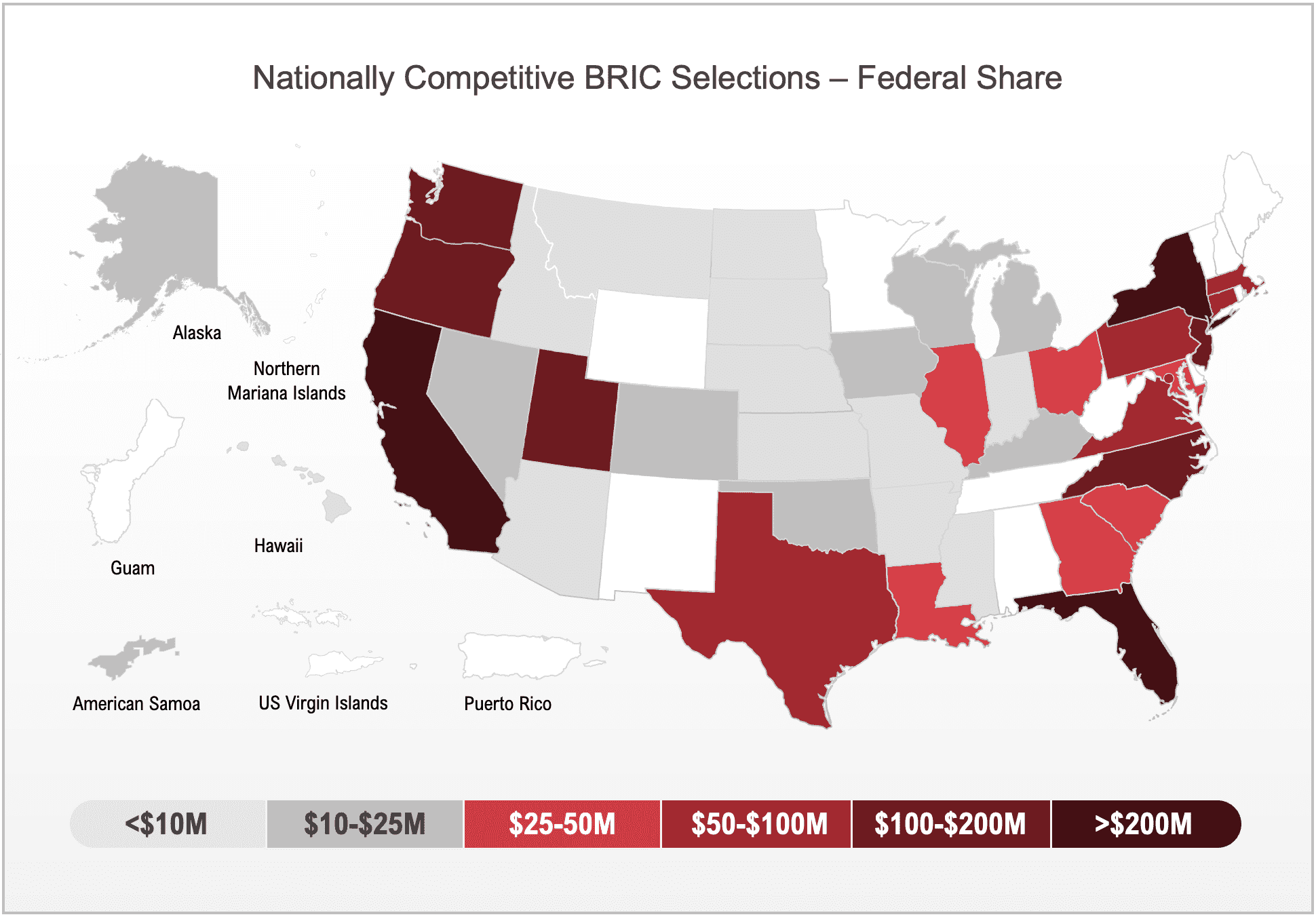
Source: FEMA Open Data
This divergence between those positioned to win and those repeatedly falling short became one of the defining challenges of the BRIC program. At the same time, the program itself was expanding rapidly.
- In 2020, BRIC began as a $500 million annual investment.
- By 2021, mitigation funding had scaled to an unprecedented $3.46 billion, including Hazard Mitigation Grant Program (HMGP) tied to the COVID-19 disasters, Flood Mitigation Assistance (FMA), and the second year of BRIC funding.
As funding increased, so did the backlog of applications, delays in awards, and concerns about accessibility and outcomes. By early 2025, tensions intensified when FEMA cited uneven distribution of funding and limited demonstrated results, abruptly canceling the BRIC Fiscal Year (FY) 2024 Notice of Funding Opportunity (NOFO). After legal challenges from multiple states, the program was reinstated in mid-March 2026.
On March 25, 2026, FEMA released the BRIC FY 2024/2025 NOFO, making $1 billion in federal funding available to states, local governments, territories, and Tribal Nations.
BRIC FY 2024/2025: Key Changes, Priorities, and Strategic Takeaways
FEMA has made $757 million available through the nationally competitive portion of the FY 2024/2025 BRIC program. The remaining funding will be distributed as follows:
| Funding Category | Total Allocation | Per Recipient Allocation |
| State/Territory Allocations | $112 million | $2 million per state/territory |
| Tribal Set-Aside | $50 million | $2 million per applicant |
| State/Territory Building Code Plus-Up | $56 million | $1 million per state/territory |
| Tribal Building Code Plus-Up | $25 million | — |
This year’s BRIC cycle reflects a clear shift in FEMA’s priorities.
- Speed, Simplicity, and Shovel-Ready Execution. The program has been redesigned to accelerate funding, prioritizing shovel-ready infrastructure projects over longer-term or phased efforts. FEMA has eliminated phased projects and removed National Review Panel scoring, streamlining the review process and placing greater emphasis on projects that can demonstrate readiness and measurable risk reduction at the time of application.
- Infrastructure-Centric Risk Reduction with Shorter Timelines. This round focuses on capability- and capacity-building activities tied directly to infrastructure protection, as well as projects that reduce risk to critical infrastructure from natural hazards. FEMA emphasizes “investment in infrastructure and construction projects that deliver immediate, measurable risk reduction to communities vulnerable to natural hazards.” The maximum period of performance has also been reduced from 48 months to 36 months, increasing the importance of realistic scopes, disciplined schedules, and strong project management.
- Design Readiness as a Primary Competitive Differentiator. One of the most significant changes is FEMA’s stronger preference for projects with substantial design work already completed. Projects with 90 percent design or greater will receive the highest score under the design-readiness criterion (30 points), compared with projects at approximately 30 percent design (15 points) or conceptual design (5 points). In practical terms, this means communities with well-developed projects will be far more competitive than those still in early planning phases.
- Building Codes Prioritized. Building codes remain a major priority. Communities that have adopted the 2021 or 2024 International Code Council (ICC) model codes and maintain a Building Code Effectiveness Grading Schedule (BCEGS) rating of one to five can receive 15 points. At the same time, FEMA has deemphasized ancillary and equity-based considerations that featured more prominently in prior rounds.
- Shift Away from Ancillary Scoring Factors. This year, there are no points tied to Justice40 communities, Community Disaster Resilience Zones, or economically disadvantaged rural communities identified through the Climate and Economic Justice Screening Tool (CEJST). Similarly, projects with secondary benefits such as habitat restoration, carbon sequestration, or reduced social vulnerability will no longer receive the same level of scoring emphasis.
It is important to note that FEMA will not fund the development of hazard mitigation plans under this round of funding.
Who Should Apply
Eligible applicants include territories, state agencies, cities, towns, counties, special districts, and Tribal Nations with FEMA-approved and locally adopted hazard mitigation plans. Those plans must be current and unexpired both at the time of subapplication and at the time of award. Private nonprofit organizations are not eligible to apply directly as subapplicants, but they may be sponsored by an eligible subapplicant. All interested subapplicants should coordinate early with their applicant agency to understand state-, territory-, or Tribe-specific processes and deadlines.
BRIC generally requires a 25 percent nonfederal cost share. Match sources may include cash, donated resources, in-kind services, materials, or a combination of these. Small, impoverished communities—defined as communities with 3,000 or fewer residents and a per capita annual income not exceeding 80 percent of the national per capita income—may qualify for a reduced 10 percent local cost share.
Eligible Activities and Project Types
- Capability and Capacity Building: Eligible when directly tied to infrastructure projects. Activities include building code adoption and enforcement, as well as project scoping for specific infrastructure investments. Eligible scoping activities may include design work for hazard-resistant infrastructure, environmental and historic preservation review, engineering and technical analyses, site selection, alternatives analysis, benefit-cost analysis (BCA) development, and subapplication development for future funding rounds. Notably, subapplicants seeking these activity types are exempt from the hazard mitigation plan requirement.
- Building Code Plus-Up: Supports activities related to building code adoption, implementation, enforcement, and workforce development. These activities help jurisdictions adopt and enforce the current or next-most-recent hazard-resistant model codes—specifically the 2021 or 2024 International Building Code (IBC) and International Residential Code (IRC). The maximum allocation under this category is $1 million per state or territory, making prioritization critical. States will need to focus on the code-related activities that offer the clearest resilience benefits and align most closely with state priorities.
- Hazard Mitigation Projects: Must demonstrate a clear and direct connection to critical infrastructure systems and show how the project will reduce natural hazard risk. Projects must also demonstrate cost effectiveness, generally through FEMA’s BCA Toolkit version 6.0. Physical work may not begin prior to the award, and all projects must be completed within 36 months.
FEMA is explicitly prioritizing shovel-ready projects. Every application must include at least a conceptual design, and more advanced designs will earn substantially more points. Projects must also include a Go/No-Go milestone—a major implementation checkpoint that, if missed, could result in FEMA canceling the award. The federal share for mitigation projects is capped at $20 million; therefore, larger projects will require a higher non-federal contribution.
Management Costs
Management costs are available to subapplicants with awarded projects to support award administration and compliance. These costs do not require a cost share and do not count against project benefits in the BCA. Eligible uses include quarterly reporting, reimbursement support, closeout activities, indirect costs, subapplication development, BCA preparation, project design, and environmental and historic preservation work. Management costs are capped at five percent of the total project cost, inclusive of both federal and local shares.
Win Strategy and Themes
Competitive applications this year will share several defining characteristics. First, they will demonstrate a strong and direct connection to protecting critical infrastructure from natural hazards. Second, they will show a high level of design readiness, ideally 90 percent design or greater. Third, applicants who have adopted the 2021 or 2024 IBC/IRC and maintain a BCEGS rating between one and five will have a meaningful scoring advantage.
FEMA is also attempting to broaden access to BRIC funding by awarding 15 points where either the applicant or subapplicant has not previously received BRIC funding. This creates an opening for jurisdictions that have historically been unsuccessful under the program. Successful applications will clearly explain how the project reduces natural hazard risk, and they will show strong cost controls, schedule discipline, and implementation strategies.
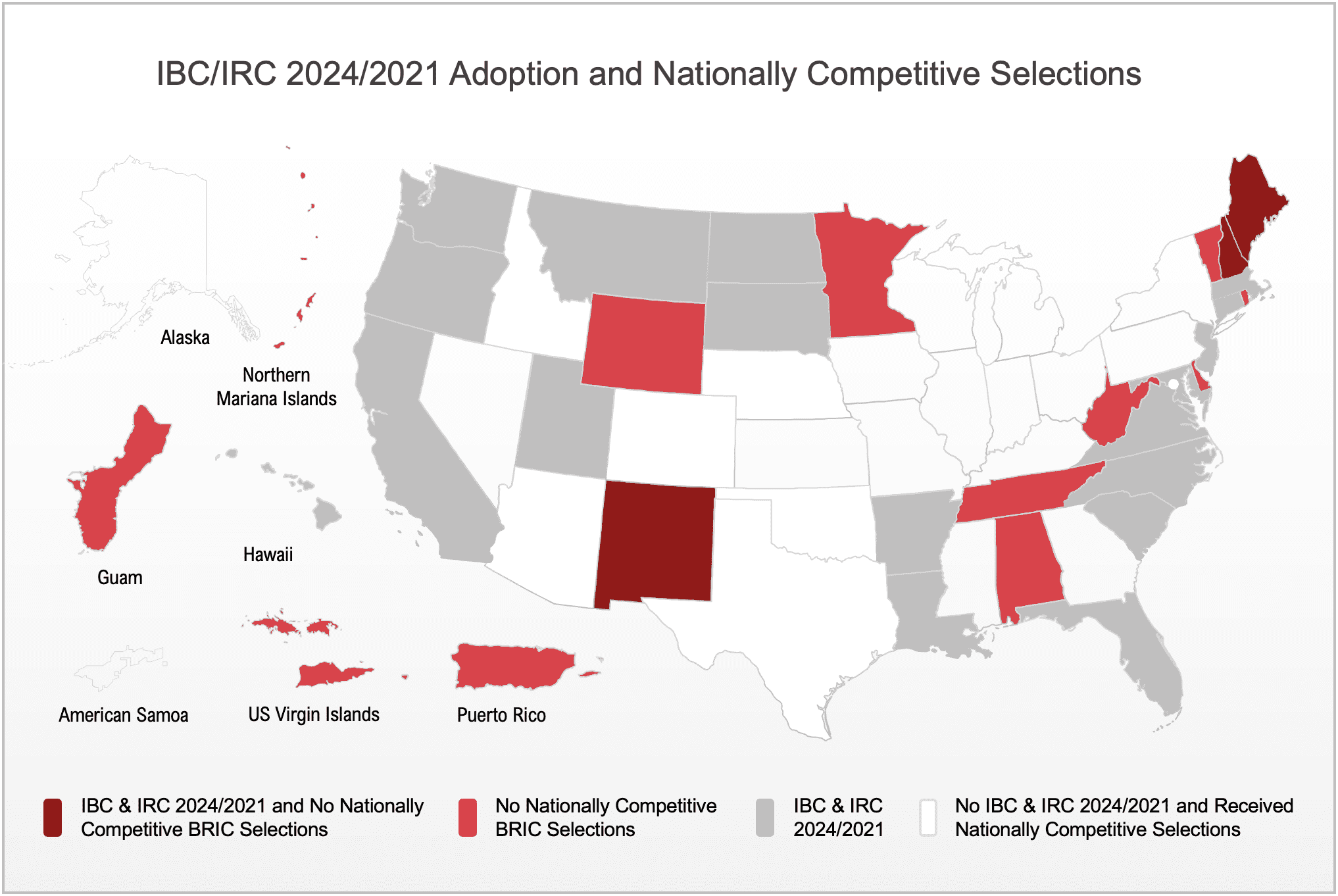
Source: FEMA Open Data and Advocacy – ICC
On the Horizon: Preparing for BRIC FY 2026
A new BRIC NOFO is expected in Fall 2026 and is likely to closely mirror the FY 2024/2025 structure. For jurisdictions not positioned to apply in the current cycle, now is the time to prepare.
To be competitive in FY 2026, potential subapplicants should focus on the following actions:
- Review the current NOFO to understand program priorities, scoring criteria, and eligibility requirements, as future guidance is expected to align closely.
- Identify and refine potential projects that clearly reduce risk to critical infrastructure and can demonstrate strong design readiness. Projects that are viable but early in design should advance design now, as these costs may be eligible as pre-award expenses in future rounds.
- Develop a credible cost estimate using industry best practices to ensure accuracy and defensibility.
- Complete a BCA to demonstrate cost-effectiveness.
- Advance environmental and historic preservation review, including documentation required to support FEMA’s National Environmental Policy Act (NEPA) process.
Early investment in project development, design, and documentation will be critical to competing successfully in the next BRIC cycle.
Hagerty Can Help
While BRIC projects require a nonfederal cost share, FEMA does fund management costs. These costs are capped at five percent of total project costs and support the administration of awarded mitigation projects. Ultimately, this creates an opportunity for Hagerty to support your application and project delivery with minimal to no additional cost to your organization.
Hagerty’s Mitigation team has deep expertise in navigating both pre- and post-disaster federal funding programs. We help clients not only compete for BRIC funding, but also position projects for success from concept through implementation.
Our support includes:
- Project scoping and strategy development: Developing a clear, competitive Scope of Work (SOW) that defines project purpose, approach, feasibility, and outcomes
- Schedule and implementation planning: Building detailed, realistic work schedules aligned to all project milestones and FEMA requirements
- Cost estimating and documentation: Preparing defensible cost estimates and narratives that fully capture total project costs
- BCA assistance: Completing robust BCAs to demonstrate cost-effectiveness and strengthen competitiveness
- Environmental and historic preservation (EHP) support: Identifying and documenting EHP considerations to streamline FEMA review
- Application positioning and compliance: Addressing key scoring factors such as design readiness, shovel-ready status, and avoidance of duplication of benefits
From early project development through application and award, Hagerty provides the technical expertise and strategic guidance needed to maximize funding opportunities and reduce risk.