On April 30, 2026, the Federal Emergency Management Agency (FEMA) issued amended Notices of Funding Opportunity (NOFOs) for the Fiscal Year (FY) 2024 Flood Mitigation Assistance (FMA) and FMA Swift Current programs.
Together, the updated programs make more than $1.1 billion available to help communities reduce flood risk, protect infrastructure, and lower future National Flood Insurance Program (NFIP) claims.
FEMA’s revised guidance signals an important shift in how the agency plans to prioritize flood mitigation funding moving forward. Increasingly, FEMA appears focused on projects that demonstrate clear, measurable reductions in future flood losses and strong implementation readiness. As a result, communities with well-developed, implementation-ready projects will likely have the strongest advantage. Because of this funding availability, local governments, floodplain managers, and emergency management leaders should begin preparing now rather than waiting for the next disaster declaration or grant deadline.
Moreover, the Infrastructure Investment and Jobs Act (IIJA), also known as the Bipartisan Infrastructure Law (BIL), provided approximately $3.5 billion in supplemental funding for the FMA program between Fiscal Years 2022 and 2026. As a result, annual funding levels near $600 million could continue through the remaining years of IIJA funding.
For communities facing recurring flooding, containing repetitive/severe repetitive loss properties, and increasing pressure on local infrastructure, the updated FMA and Swift Current programs may represent some of the most significant federal flood mitigation funding opportunities currently available.
Key Programmatic Changes
FEMA’s updated guidance for FMA and Swift Current programs signals a clear shift in how the agency plans to prioritize flood mitigation funding moving forward. The revised 2024 NOFOs removed several climate, equity, and partnership-focused scoring considerations included in previous guidance, including references to Justice40 communities, Community Disaster Resilience Zones, nature-based solutions, and certain public-private partnership incentives.
Instead, FEMA now appears focused on projects that can clearly demonstrate measurable reductions in future flood losses and NFIP claims. As a result, communities with repetitive loss (RL) properties, severe repetitive loss (SRL) properties, or recurring flood impacts will likely have a strong advantage in future funding cycles. FEMA defines RL and SRL properties as NFIP-insured structures that have experienced repeated flood insurance claims over time. These properties often represent some of the highest-risk and costliest flood-prone structures in the NFIP and remain a major priority for FEMA mitigation funding.
At the same time, FEMA continues prioritizing projects that provide long-term flood risk reduction rather than temporary improvements. Consequently, acquisitions, elevations, drainage improvements, mitigation reconstruction, and flood control infrastructure projects will likely remain among the strongest candidates for funding consideration.
The FMA Program
The FMA program provides competitive funding to states, territories, local governments, and federally recognized Tribal Nations for projects that reduce long-term flood risk and repetitive flood damage to National Flood Insurance Program (NFIP)-insured structures.
The 2024 FMA cycle makes $600 million available for flood mitigation activities nationwide, including property elevations and acquisitions, hazard mitigation planning, technical assistance, project scoping, and flood control infrastructure improvements.
Unlike some FEMA mitigation programs, FMA continues supporting larger-scale flood mitigation projects when applicants can demonstrate a strong connection to NFIP-insured properties and repetitive flood losses. In addition, FEMA did not establish an overall applicant funding cap for FMA this year, creating additional flexibility for communities pursuing larger mitigation efforts.
The program also continues offering favorable cost-share opportunities. In most cases, FEMA provides a 75 percent federal cost share with a 25 percent local match requirement. However, FEMA may increase the federal share for qualifying repetitive loss properties. FEMA-defined RL properties may qualify for a 90 percent federal cost share, while SRL properties may qualify for 100% federal funding. FEMA also allows management costs up to 10 percent of the applicant’s aggregate subapplication budgets, helping communities offset grant administration expenses.
Historically, FEMA has directed significant FMA funding toward communities with high concentrations of repetitive flood losses and NFIP claims, particularly along the Gulf Coast, have consistently received funding for elevations, acquisitions, and other flood mitigation activities tied to recurring flood disasters.
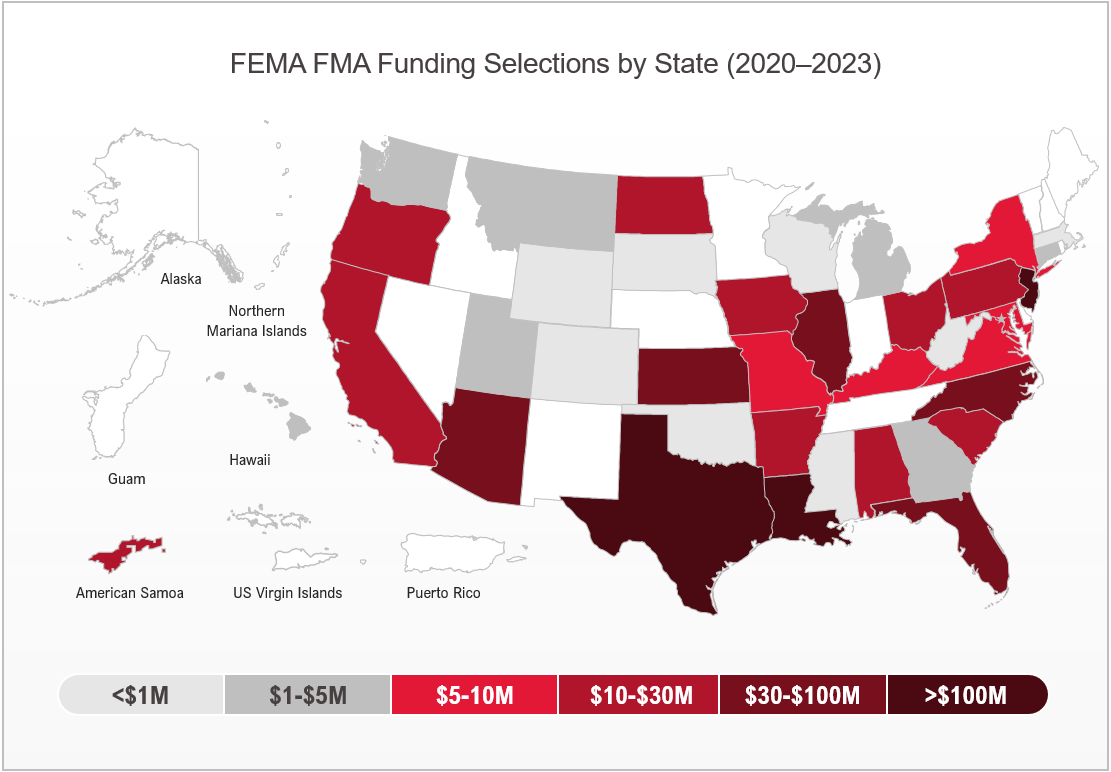
Source: OpenFEMA – HMA Subapplications (V2)
However, communities nationwide facing recurring flood impacts may find the current FMA cycle increasingly attractive as FEMA continues emphasizing projects that reduce long-term flood risk and future NFIP claims.
The Swift Current Program
The Swift Current program provides post-disaster mitigation funding to states, territories, and federally recognized Tribal Nations to help communities more quickly reduce repetitive flood damage following major flood events. The program focuses primarily on reducing repetitive flood damage to National Flood Insurance Program (NFIP)-insured properties, particularly RL, SRL, and substantially damaged (SD) structures.
Unlike the broader FMA program, Swift Current focuses mainly on Individual Flood Mitigation projects and Project Scoping activities. FEMA made $500 million available through the program to help communities reduce future flood losses and strengthen resilience.
Swift Current operates differently than traditional FEMA mitigation grant programs by using a rolling application process managed through each state following qualifying flood-related disaster declarations rather than a single national deadline. Communities impacted by coastal storms, hurricanes, and flood events between June 1, 2024, and May 31, 2025, may qualify for funding, and applicants who receive additional qualifying flood disaster declarations may also become eligible for additional Swift Current activations.
Additionally, FEMA distributes funding through Applicant Maximum Set-Asides based largely on NFIP claims activity and disaster impacts. Eligible applicants may receive up to $40 million for Individual Flood Mitigation projects tied to substantially damaged NFIP-insured structures, with up to 1 percent of the maximum set aside for project scoping. United States (US) Territories applying directly to FEMA may use up to 5 percent of their maximum set-aside for project scoping.
To qualify, applicants or subapplicants must generally meet at least one of the following thresholds:
- At least $1 million in NFIP flood insurance claims during the 12 months prior to the disaster declaration
- 500 or more NFIP flood insurance claims resulting from the declared flood event
- Status as a US Territory or federally recognized Tribal government
The program also continues offering favorable cost-share opportunities for repetitive flood loss properties. FEMA may provide a 90 percent federal cost share for qualifying RL properties and up to 100 percent federal funding for eligible SRL properties. In addition, FEMA allows management costs to help support grant administration and project delivery.
Not So Swift: Ongoing Funding Delays
Although FEMA continues making significant mitigation funding available through both the FMA and Swift Current programs, obligation timelines remain a challenge. Between FY 2020 and 2023, FEMA obligated only 346 of the 617 selected FMA applications, representing approximately $566 million of the $1.8 billion made available during that period. In addition, FEMA’s HMA Mitigated Properties data suggests that Swift Current has not consistently achieved its intended expedited delivery timelines, with many selected subapplications experiencing delays between selection and obligation.
As a result, communities may face extended implementation timelines, delayed mitigation benefits, and increased project costs while waiting for funding obligations to move forward. In some flood-prone areas, jurisdictions have experienced additional flood events before previously selected mitigation projects received funding.
Given these ongoing delays, communities should begin developing projects, identifying repetitive loss properties, and organizing application materials as early as possible rather than waiting for future NOFO releases or disaster events. Early project development, updated NFIP claims data, and implementation-ready scopes of work may help communities move more quickly once funding opportunities become available.
Strategies to Improve FMA and Swift Current Competitiveness
As FEMA continues prioritizing projects that demonstrate measurable flood risk reduction, repetitive loss mitigation, and strong implementation readiness, communities should begin positioning projects early to improve competitiveness under both the FMA and Swift Current programs. Communities that develop clear project scopes, maintain accurate NFIP data, and focus on long-term flood risk reduction may be better positioned to maximize scoring potential, strengthen subapplications, and improve overall project success.
- Prioritize Projects That Deliver Measurable Flood Risk Reduction: Communities seeking funding under the FMA and Swift Current programs should focus on projects that clearly reduce future NFIP claims, address repetitive flood damage, and demonstrate strong long-term community benefit. FEMA continues prioritizing projects that substantially reduce flood risk to NFIP-insured structures, particularly RL and SRL properties. As a result, projects that do not significantly reduce future flood impacts may be less competitive for funding consideration. For many applicants, acquisition projects remain among the strongest candidates because they permanently eliminate flood risk by removing structures from harm’s way and preserving the property as open space in perpetuity.
- Strengthen CRS and CTP Participation: FEMA continues encouraging participation in the Community Rating System (CRS) and Cooperating Technical Partners (CTP) programs. CRS participation promotes floodplain management practices that exceed minimum NFIP requirements while also helping communities reduce flood insurance costs for residents. In addition, both CRS and CTP participation may help applicants earn additional scoring points during FEMA’s project review process.
- Consider FMA for Larger Flood Mitigation Projects: Because the Building Resilient Infrastructure and Communities (BRIC) program currently includes a $20 million federal cost share cap, some communities may find larger flood mitigation projects more competitive under the FMA program when NFIP-insured properties are located within the project area. Since FEMA cannot award duplicate funding for the same project, some applicants may also consider pursuing multiple funding opportunities strategically depending on anticipated award timelines.
- Maintain Accurate NFIP Claims Data: Communities should also maintain accurate and up-to-date NFIP claims data throughout project development. Strong coordination with FEMA, local floodplain administrators, and building officials can help communities more quickly identify RL, SRL, and substantially damaged properties as flood events occur. Because flood events can alter property classifications and claims data over time, communities with existing Information Sharing Access Agreements (ISAAs) may be better positioned to rapidly develop competitive subapplications once NOFOs are released.
- Engage the Community Early: Strong community engagement remains critical to successful Individual Flood Mitigation projects. Communities should begin developing outreach materials, identifying interested property owners, and preparing engagement strategies as early as possible. Emergency management leaders may also benefit from establishing virtual outreach platforms and informational resources before future NOFO releases to help accelerate project development and improve community participation.
- Focus on the Most Vulnerable Areas: Communities should prioritize projects that maximize reductions in future flood losses and clearly align with FEMA’s scoring priorities. Projects focused on repetitive loss and severe repetitive loss properties, particularly those using a broader community-based mitigation approach, will likely remain among the strongest candidates for future funding consideration.
Additionally, FEMA will host a webinar on Thursday, May 28, from 2–3:30pm (Eastern) to review the FY 2024 funding opportunity amendments. The webinar will cover eligibility requirements, program priorities, application details, and guidance for submitting high-quality subapplications and applications. Register to attend here.
Hagerty Can Help
FEMA allows applicants to use management costs under the FMA program to support grant administration and project delivery, helping communities offset a portion of the costs associated with developing and managing mitigation projects.
Hagerty’s Mitigation team supports clients throughout the full lifecycle of FEMA mitigation funding — from early project development through application, award, and implementation. Our team helps communities strengthen competitiveness, improve project readiness, and navigate complex federal mitigation requirements with greater efficiency and reduced risk. Our support includes:
- Project scoping and mitigation strategy development
- FEMA-compliant cost estimating and documentation
- Benefit-Cost Analysis (BCA) development
- Environmental and Historic Preservation (EHP) coordination
- Application development and review
- Schedule and implementation planning
- Grant compliance and project delivery support
As FEMA continues prioritizing projects that demonstrate measurable flood risk reduction and implementation readiness, communities that begin preparing early may be better positioned to compete for future FMA and Swift Current funding opportunities.