Indicators point to the potential for another year of elevated wildfire activity, driven by persistent drought, above-average temperatures, and increasingly dry fuels across many parts of the country. While seasonal outlooks provide valuable insight into where wildfire risk may be elevated, experience has shown that forecasts tell only part of the story. The ultimate impact of a wildfire is often determined by how well communities prepare, how effectively agencies coordinate before and during an incident, and how quickly critical decisions are made as conditions evolve. Investing in preparedness, mitigation, and strong partnerships remains one of the most effective ways to reduce risk and improve outcomes when wildfires occur.
2026 National Wildfire Risk
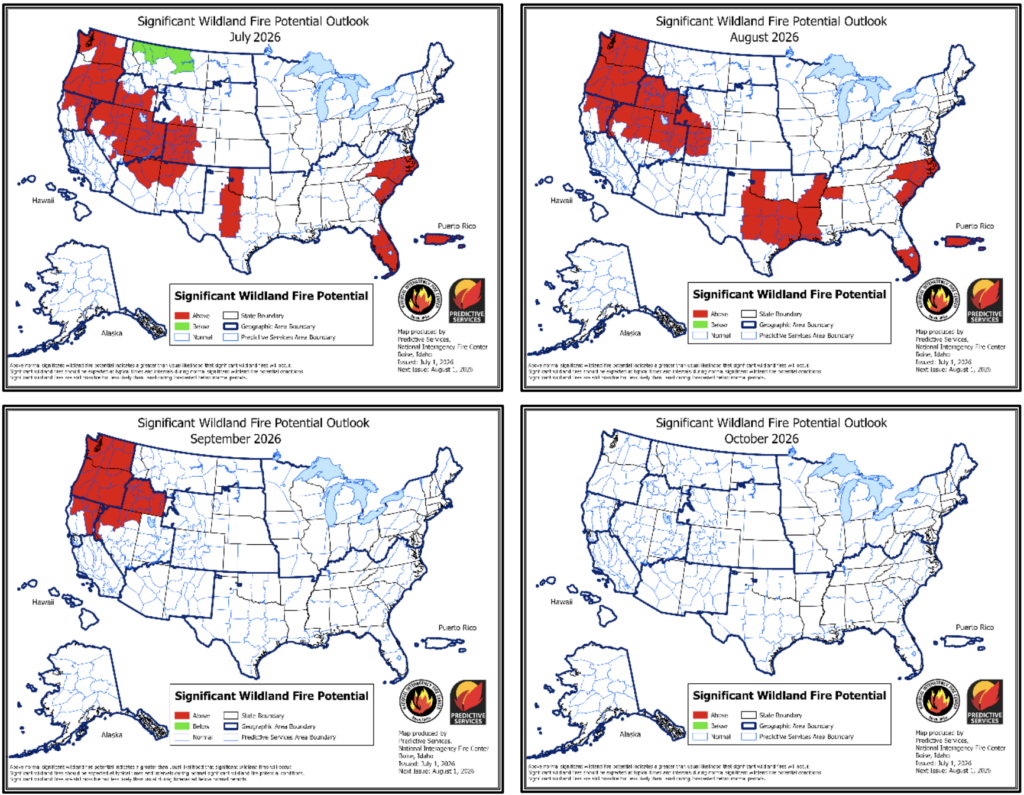
According to the National Interagency Fire Center’s (NIFC) latest outlook, wildfire activity in the United States (US) is already off to an above normal start this year and already outpacing historical averages. As of July 6, more than 37,000 wildfires have burned approximately 3.3 million acres nationwide—roughly 58 percent more acreage than burned by this time last year and well above the 10-year average.
The NIFC attributes much of this activity and increased risk to persistent drought conditions, above-average temperatures, below-normal precipitation, and significantly reduced snowpack across the western US. Snowpack deficits have been particularly severe across portions of California, the Great Basin, the Rockies, and the Southwest. These conditions have accelerated vegetation drying and increased the availability of wildfire fuels heading into peak wildfire months.
Source: NIFC Predictive Services
Looking ahead, wildfire potential is expected to remain elevated across much of the western and southern US through August, particularly in areas experiencing prolonged drought, above-average temperatures, and below-normal precipitation. The greatest risk is forecast across portions of the Pacific Northwest, Northern California, the Great Basin, and parts of the Southeast, where critically dry fuels and extreme heat are expected to persist into late summer.
Lessons Learned from Past Wildfires
Brian Baker, Vice President at Hagerty Consulting, has spent decades supporting emergency management, disaster response, and recovery operations. Having worked alongside state and local agencies through some of the nation’s most devastating wildfires, he has seen firsthand how the wildfire landscape has evolved—and what communities must do to stay ahead of growing risks.
“As changing weather patterns drive more extreme heat, prolonged drought, and increasingly dry vegetation, wildfires are igniting, spreading, and behaving in ways we have never experienced before,” Baker said. “Across the Western US, communities are facing larger, faster-moving, and more destructive wildfires that are challenging even the most prepared jurisdictions.”
According to Baker, these events have reinforced an important reality: wildfire resilience requires far more than an effective emergency response. It depends on proactive planning, timely public communication, resilient infrastructure, and strong partnerships among government agencies, private-sector organizations, and community stakeholders before, during, and after disaster strikes.
Wildfire Response: Early Alerts Save Lives
One of the most important lessons from recent wildfire disasters is that timely, accurate, and actionable communication saves lives.
As wildfire behavior becomes more unpredictable, communities have less time to react. Early evacuation alerts give residents the opportunity to leave safely before smoke, fire, or traffic make evacuation routes impassable. Clear communication also reduces confusion, eases congestion, and helps emergency responders operate more effectively.
While local emergency management agencies are responsible for issuing evacuation notices, residents living in wildfire-prone areas play an equally important role in their own preparedness.
Ready.gov recommends several simple but critical steps:
- Sign up for emergency alerts. Register for local text messages, emails, or emergency notification systems to receive real-time evacuation orders, wildfire updates, and emergency information.
- Prepare a Go Bag. Pack emergency supplies for every member of your household—including pets. Focus on the “5 P’s”: People and Pets, Prescriptions, Papers, Personal Needs, and Priceless Items.
- Practice your evacuation plan. Review evacuation routes and family communication plans regularly, so everyone knows what to do when every minute matters.
Wildfire Recovery Requires Long-term Partnership
“The work doesn’t end when the flames are out—in many ways; that is when the hardest work begins,” Baker said.
Wildfire recovery is a long, complex process that can take years. Families and businesses often face hazardous debris removal, delayed insurance settlements, labor shortages, rising construction costs, limited housing availability, supply chain disruptions, and environmental hazards that linger long after the fire is contained.
“In every major wildfire I have worked, recovery has been about much more than rebuilding structures,” Baker said. “It’s about restoring communities, helping people navigate an incredibly complicated process, and making sure we’re rebuilding in a way that reduces future risk.”
According to Baker, successful recovery depends on strong coordination across every level of government and the private sector.
“No single organization can do this alone,” he said. “When public agencies, insurers, builders, nonprofit organizations, and community leaders are aligned, communities recover faster. Streamlining permitting, coordinating resources, solving housing challenges, and investing in resilience from day one all make a meaningful difference in how quickly people can get back on their feet.”
“The goal is not simply to restore what was lost,” Baker added. “It is to rebuild stronger, safer, and better prepared for the next wildfire.”
Building More Wildfire-Resilient Communities
The most effective wildfire strategy begins long before an evacuation order is issued.
Homeowners can significantly reduce wildfire risk through home hardening—making targeted improvements that help structures withstand embers, radiant heat, and direct flame exposure, which remain the leading causes of home loss during wildfires.
Fire-resistant roofing and siding, ember-resistant vents, enclosed eaves, defensible space landscaping, and regular vegetation management all improve a home’s ability to survive a wildfire.
For example, in the State of California, Both CAL FIRE and Cal OES identify home hardening as one of the most effective wildfire mitigation investments available today. Through the California Wildfire Mitigation Program (CWMP), eligible low- and moderate-income homeowners can access education, technical assistance, and financial support to retrofit homes in high-risk wildfire communities.
As wildfire risk continues to grow, investments in mitigation not only protect individual homes—they strengthen entire communities and reduce future recovery costs.
Know Your Risks, Be Prepared
Wildfires are no longer seasonal events—they are an increasingly persistent threat that demands year-round planning and investment. As fire behavior becomes more complex and communities continue to grow in high-risk areas, resilience must be built into every phase of emergency management—from mitigation and preparedness to response and long-term recovery.
The communities that will be most successful are those that take action before disaster strikes. By investing in emergency planning, strengthening public-private partnerships, modernizing communication systems, and rebuilding with resilience in mind, jurisdictions can better protect lives, reduce losses, and recover stronger from future wildfire events.
Hagerty will continue to share perspectives on preparedness, response operations, and long-term recovery throughout the coming months. For ongoing updates on risk outlooks, funding opportunities, and wildfire activity nationwide, consider subscribing to Hagerty’s monthly newsletter.