According to the National Interagency Fire Center (NIFC), as of Tuesday, August 11, 104 uncontained large active wildfires have collectively burned 3,823,815 million acres across the country this summer. The Northwest remains the nation’s most active fire area with 45 uncontained large fires. States experiencing the highest volume of wildfire activity including Oregon with 24 active fires, followed by Washington (20), Idaho (10), and Montana (9). On Monday, August 10, the Federal Emergency Management Agency (FEMA) approved Fire Management Assistance Grants (FMAGs) for the Bug Fire in Nevada, the Wrights Spring Fire and Hagen Fire in Oregon, and Rocky Canyon Fire in Utah.
This year, Utah, Oregon, and Washington are each experiencing historic wildfire seasons. In Utah, the roughly 474,000 acres burned this year marks the state’s second worst season on record. In Oregon, the state has broken its record for total acreage burned in a year, with more than 2.3 million acres burned in 2026 so far. Washington has also recorded more than 300,000 acres burned to date this year—its highest total since the state began tracking this data in 2016.
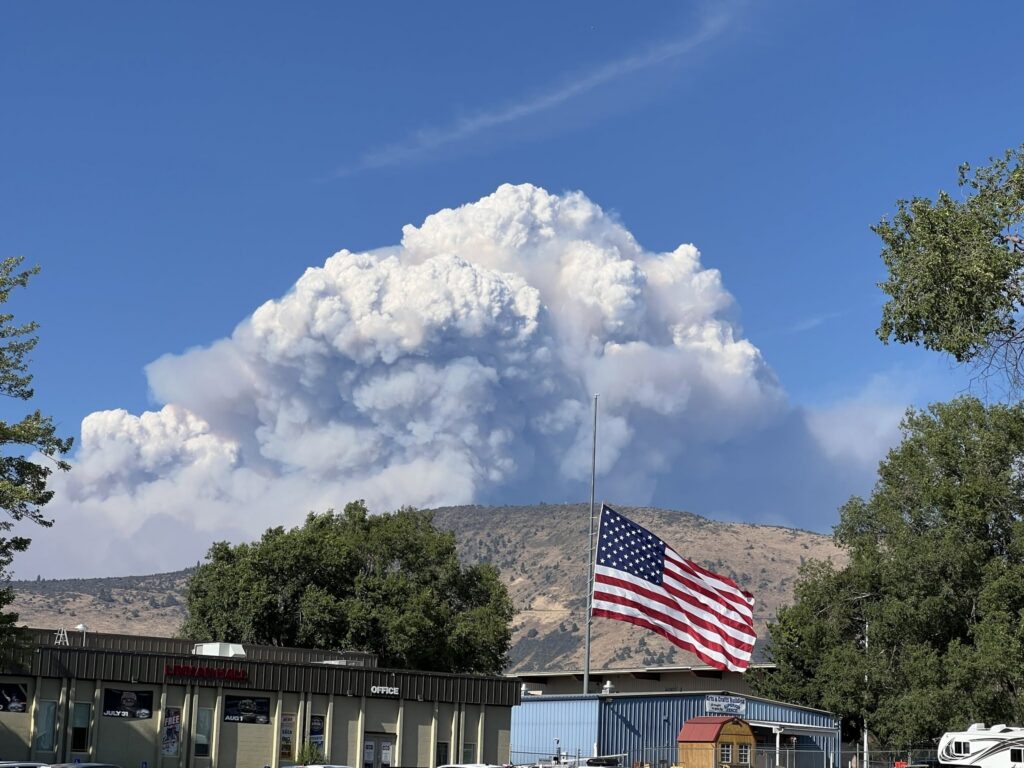
Facebook: Wrights Spring Fire
As of Tuesday, August 11, the Hagen and Wrights Spring Fires in eastern Oregon have burned 46,527 and 46,769 acres, respectively. Crews battling the Hagen Fire perimeter have achieved 11 percent containment as of Tuesday, August 11. In southwestern Oregon, the Wrights Spring Fire remains at zero percent containment as it continues to exhibit extreme fire behavior and significant growth. The Oregon Department of Forestry (ODF) also reports at least one firefighter fatality related to the Wrights Spring Fire.
Additionally, in Utah, crews are working to fight the Rocky Canyon Fire, which grew more than 3,000 acres in a 24-hour period between Monday, August 10, and Tuesday, August 11. The fire has burned 13,601 acres east of Salt Lake City in Morgan and Summit Counties, sitting at zero percent containment, as of Tuesday, August 11.
Oregon
On Wednesday, July 22, Oregon Governor Tina Kotek invoked the Emergency Conflagration Act for the Hagen Fire in Umatilla County, mobilizing statewide fire resources to support fire containment and suppression. Later, on Tuesday, August 7, Governor Kotek invoked the Emergency Conflagration Act again for the Wrights Spring Fire as it encroached on homes and structures in Klamath County and Klamath Tribes’ tribal lands. Throughout 2026, Oregon has experienced a record year for wildfire activity. As of ODF’s latest report on Monday, August 10, wildfires have burned 2,336,713 acres across the state this year—already surpassing the previous record of 1.93 million acres set in 2024.
According to FEMA, as of Tuesday, August 11, the Hagen and Wrights Spring Fires collectively threaten more than 2,800 homes. Additionally, as of August 11, nearly 900 commercial structures are at risk as the Wrights Spring Fire spreads southeast towards the Bly Mountain region. Along the Oregon–Idaho border, the Big Grass Fire nears the record for Oregon’s largest wildfire on record, the 2012 Long Draw Fire, which burned 557,648 acres. As of Tuesday, August 11, the Big Grass Fire has burned 553,972 acres and sits at 35 percent containment.
Rocky Canyon Fire — Utah
On Friday, August 7, the Rocky Canyon Fire was identified near the East Canyon Reservoir in Morgan County, Utah. On Monday, August 10, many residents of Henefer in neighboring Summit County, Utah, were ordered to evacuate due to growing threats posed by thunderstorms and wind. On Monday, the US Forest Service reported that the fire has mostly burned on Utah State Park lands, but continues moving eastward towards Franklin and Summit Counties, where residents should exercise enhanced caution.
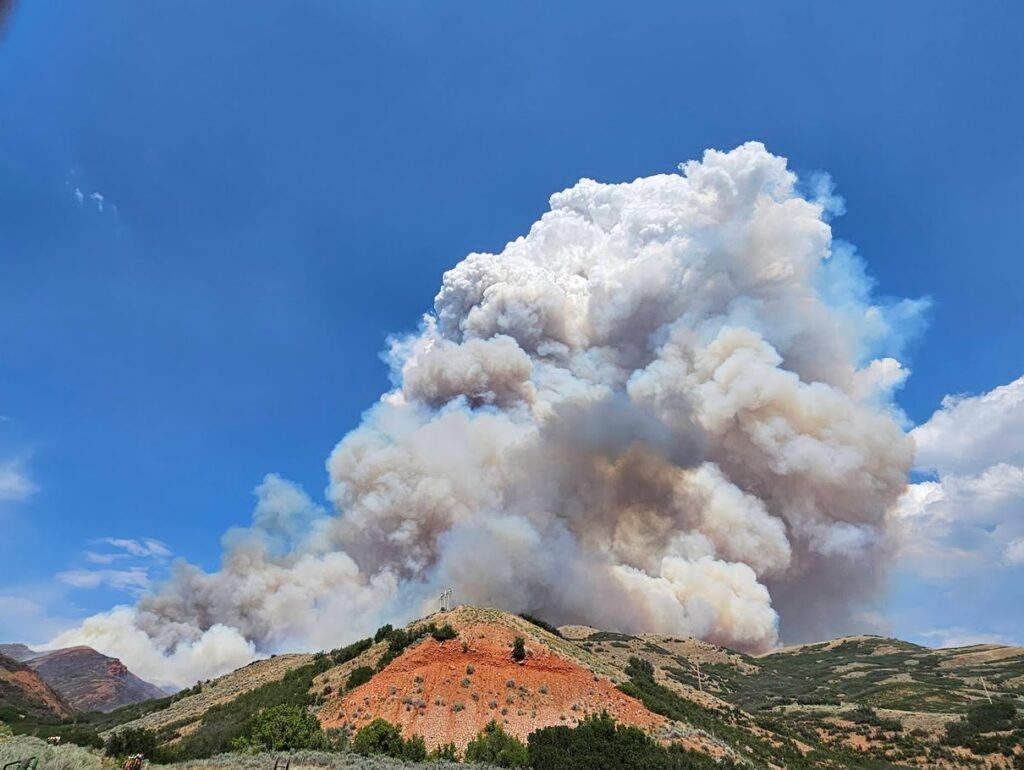
Facebook: Utah Fire Info
On Tuesday, August 11, Utah’s official fire communication site released that the fire is now 23 percent contained and has burned over 13,600 acres Despite increased fire activity, first responders are hopeful based on the successful deployment of crew and materials and the increase in humidity that has made conditions more favorable for fighting the fire. In response to the threats caused by the fire, FEMA authorized a FMAG to help with firefighting costs.
Additional Fires
In Washington, firefighters have been responding to the Little Giant Fire since its ignition on Wednesday, July 15, near the town of Leavenworth, Washington. Between Saturday, August 8, and Sunday, August 9, the fire destroyed multiple homes and at least 26 structures in the upper Entiat Valley. Officials report the fire continues to exhibit extreme fire behavior as of Tuesday, August 11, and has burned over 111,429 acres. Currently, the fire sits at two percent containment. Further east, in Spokane, Washington, crews have achieved at least 73 percent containment of the three fires known as the Spokane Fire Complex. Since ignition on Saturday, August 1, the fires damaged or destroyed over 800 structures across the Spokane region.
Overall, as of Monday, August 10, more than 720,000 acres have burned across Washington this year—nearly two percent of the state’s total land area. In early August President Trump approved an emergency declaration for the state. Following this declaration, on Friday, August 7, the United States (US) Department of Health and Human Services (HHS) issued a Public Health Emergency to support the delivery of healthcare services to impacted individuals and communities.
Along the northern California–Nevada border, the Bug and Fred Mountain Fires have collectively burned more than 16,000 acres around Washoe County and the Reno-Sparks Indian Colony. Due to evacuation and power outage impacts across the region, the Washoe County School District announced that eight schools would remain closed from Monday, August 10, to Tuesday, August 11. Additionally, Nevada Governor Joe Lombardo declared a state of emergency on Tuesday, August 11, effective through Monday, August 17, unless conditions improve.
Wildfire Smoke Effects Air Quality
As of Tuesday, August 11, Air Quality Alerts remain in effect for eight counties across central and eastern Washington as wildfire smoke continues to push air quality into the Unhealthy to Very Unhealthy range. The Air Quality Index (AQI) is driven by data which measures air pollution on a scale of zero to 500. A value between zero and 50 is considered to have little or no health risk, while anything above 200 or 300 is considered very unhealthy or hazardous, respectively, increasing the risk of health effects for everyone. Air quality impacts have also been observed across the state of Oregon. According to AirNow, as of Tuesday, August 11, multiple cities in Oregon are experiencing levels in the Unhealthy to Hazardous range, with the city of Prineville recording levels up to 440.

Know Your Risks, Be Prepared.
Wildfires are a year-round threat that can occur anywhere in the country, often spreading rapidly and changing conditions with little warning. FEMA urges individuals and communities to take preventive measures with protecting their property and loved ones in the event of a wildfire emergency.
To stay safe during a wildfire, pay close attention to emergency alerts and notifications, evacuating immediately if instructed by authorities. Keep track of fires in or near your area by listening to the Emergency Alert System (EAS) and NOAA Weather Radio for emergency alerts and using AirNow’s Fire and Smoke Map and NOAA’s Fire Weather Outlook.
According to AirNow, the biggest health risk of wildfire smoke is fine particles. These microscopic particles can get into your eyes and respiratory system, where they can cause health problems such as burning eyes, runny nose, and pulmonary illnesses such as bronchitis. Fine particles can also aggravate chronic heart and lung diseases. The Centers for Disease Control and Prevention (CDC) suggests the following measures to help protect against wildfire smoke:
- Check your community’s outdoor air quality using the AQI at airnow.gov or on your phone’s weather app;
- Stay inside if authorities advise you to do so;
- Keep smoke outside by designating a room you can close off from outside air, setting up a portable air cleaner or a filter, and avoiding burning anything indoors as much as possible;
- If you must go outside, wear a National Institute of Occupational Safety and Health (NIOSH) approved respirator to reduce your smoke exposure; and
- Monitor health symptoms, especially if you have asthma, Chronic Obstructive Pulmonary Disease (COPD), heart disease, diabetes, or are pregnant. Seek medical help if needed.
Stay Updated and Learn More Here:
- Visit John’s Hopkins Medicine for more information on protecting yourself and your community from poor air quality.
- Learn more about how to safely and efficiently evacuate during wildfires.
- Hagerty will continue to provide guidance on making effective preparations for long-term recovery and continue our situational updates. Consider subscribing to Hagerty’s monthly newsletter for ongoing updates on wildfire activity nationwide.