According to the Incident Information System, InciWeb, as of Tuesday, August 4, three active fires are significantly impacting and displacing communities across Spokane County, Washington. The fires include the Autumn Lane Fire, Old Trails Fire, and Fairview Fire, which have collectively burned over 10,280 acres. According to the Washington Commissioner of Public Lands, as of Tuesday, August 4, the fires are zero percent contained, placing over 10,000 structures in Spokane County at risk.
At the onset of the fires on Saturday, August 1, the National Weather Service (NWS) issued a Particularly Dangerous Situation (PDS) Red Flag Warning for Spokane County. This rare warning indicates the potential for very rapid-fire growth. That same day, Washington Governor Bob Ferguson declared a State of Emergency for the whole state. On Sunday, August 2, the Federal Emergency Management Agency (FEMA) approved the state’s request for a Fire Management Assistance Grants (FMAGs) for the Autumn Lane, Fairview, and Old Trails Fires.
SVFD remains on the fire line assisting regional partners with multiple fires within the #SpokaneComplexFire, including the #AutumnLaneFire.
Info on evacuations and fire updates:
🔥 https://t.co/jLPtwHUTpiThank you to all crews working tirelessly to protect our communities. pic.twitter.com/nNrudpeuSV
— Spokane Valley Fire (@SpokaneValleyFD) August 3, 2026
X: Spokane Valley Fire Department (SVFD)
Statewide, at least 17 active, major wildfires—including the Spokane Fires—have burned a combined total of over 260,000 acres this summer, according to the Washington Public Lands Commissioner. Officials report that the combination of high temperatures and critically dry fuels across the state is expected to contribute to increasing fire intensity and resistance to containment through Thursday, August 6.
The Spokane Fire Complex
Fueled by low humidity, strong winds, and extremely dry vegetation, the three fires—all starting on Saturday, August 1—rapidly spread and merged to form the Spokane Fire Complex. This designation is given when two or more fires are located near each other and are managed under a single Incident Command (IC) structure. The causes of the Autumn Lane and Fairview fires remain under investigation; however, Washington authorities arrested a man for first-degree arson in connection with the Old Trails Fire on Tuesday, August 4.
As of Monday, August 3, preliminary damage assessments estimate the number of structural losses to be between 700 to 1,100, according to officials. Due to the complex’s close proximity to populated areas, more than 65,000 people have been evacuated since the fires began.
State and Federal Government Response
The emergency proclamation enacted by Governor Ferguson on Saturday, August 1, runs through September 30, 2026, and establishes a prohibition on agricultural burning, land clearing, bonfires, and other outdoor burning to reduce the risk of wildfire events. Additionally, on Sunday, August 2, Governor Ferguson requested a federal emergency declaration that was approved by President Trump on Tuesday, August 4. This declaration authorizes FEMA to provide greater federal response coordination and resources necessary to save lives, protect public health and safety, and protect property as the wildfires remain a threat to thousands of structures across the state. Additionally, the State can utilize available FMAG funding to cover up to 75 percent of its eligible firefighting costs. Eligible items can include expenses for field camps, equipment use, materials, supplies, and mobilization and demobilization activities attributed to fighting the fire.
Smoke from regional wildfires has moved into W WA today. Smoke aloft will mix down to the surface later today into Tuesday and is expected to bring reduced air quality to portions of western WA into at least Wednesday. #wawx pic.twitter.com/45HQ7eNl4p
— NWS Seattle (@NWSSeattle) August 3, 2026
X: NWS Seattle
Wildfire Smoke Effects Air Quality
As of Tuesday, August 4, Air Quality Alerts have been issued for 13 Washington counties as wildfire smoke prompts Unhealthy to Hazardous air quality index (AQI) levels. The AQI is driven by data which measures air pollution on a scale of zero to 500. A value between zero and 50 is considered to have little or no health risk, while anything above 200 or 300 is considered very unhealthy or hazardous, respectively, increasing the risk of health effects for everyone.
According to AirNow, as of Tuesday, August 4, communities in Chelan County, Washington, are experiencing air quality levels up to 703. This far exceeds the hazardous threshold and is considered a health warning of emergency conditions. Air quality impacts from Washington’s wildfire smoke has also been observed in Oregon and Idaho. Levels range from Unhealthy for Sensitive Groups to Very Unhealthy across much of Oregon and western Idaho as of Tuesday, August 4.
Know Your Risks, Be Prepared.
Wildfires are a year-round threat that can occur anywhere in the country, often spreading rapidly and changing conditions with little warning. FEMA urges individuals and communities to take preventive measures with protecting their property and loved ones in the event of a wildfire emergency.
To stay safe during a wildfire, pay close attention to emergency alerts and notifications, evacuating immediately if instructed by authorities. Keep track of fires in or near your area by listening to the Emergency Alert System (EAS) and the National Oceanic and Atmospheric Administration (NOAA) Weather Radio for emergency alerts and using AirNow’s Fire and Smoke Map and NOAA’s Fire Weather Outlook.
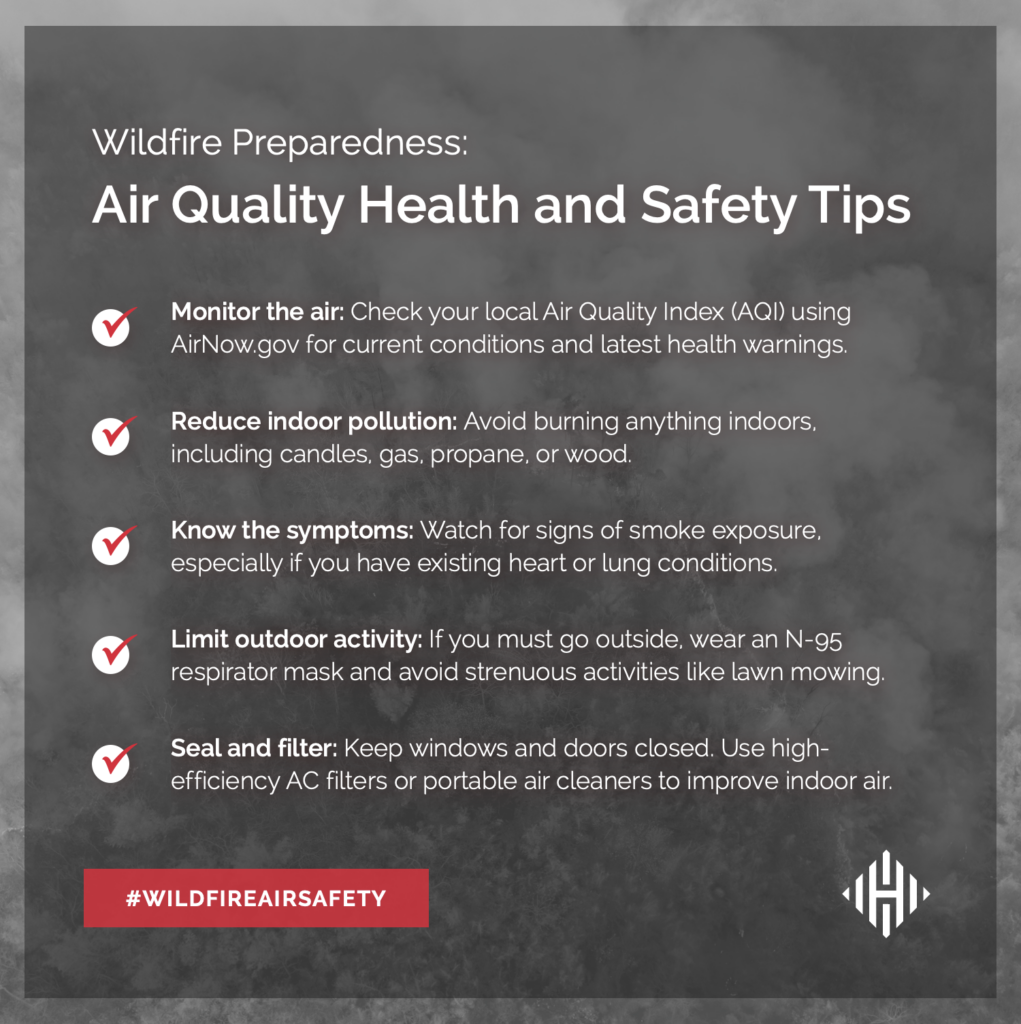
According to AirNow, the biggest health risk of wildfire smoke is fine particles. These microscopic particles can get into your eyes and respiratory system, where they can cause health problems such as burning eyes, runny nose, and pulmonary illnesses such as bronchitis. Fine particles can also aggravate chronic heart and lung diseases. The Centers for Disease Control and Prevention (CDC) suggests the following measures to help protect against wildfire smoke:
- Check your community’s outdoor air quality using the AQI at airnow.gov or on your phone’s weather app;
- Stay inside if authorities advise you to do so;
- Keep smoke outside by designating a room you can close off from outside air, setting up a portable air cleaner or a filter, and avoiding burning anything indoors as much as possible;
- If you must go outside, wear a National Institute of Occupational Safety and Health (NIOSH) approved respirator to reduce your smoke exposure; and
- Monitor health symptoms, especially if you have asthma, Chronic Obstructive Pulmonary Disease (COPD), heart disease, diabetes, or are pregnant. Seek medical help if needed.
Stay Updated and Learn More
- Visit John’s Hopkins Medicine for more information on protecting yourself and your community from poor air quality.
- Learn more about how to safely and efficiently evacuate during wildfires.
- Hagerty will continue to provide guidance on making effective preparations for long-term recovery and continue our situational updates. Consider subscribing to Hagerty’s monthly newsletter for ongoing updates on wildfire activity nationwide.